Why Moral Stories Still Matter in Today’s World
Moral stories still matter because they help people understand values through memorable experiences rather than simple rules — for children and adults alike, in every generation.
By Iyobosa Edokpolor •Updated July 2, 2026 •18 min read

💡 Quick Answer
Moral stories still matter because they help people understand values through memorable experiences rather than simple rules. They encourage empathy, critical thinking, ethical decision-making, and meaningful conversations, making them valuable for both children and adults in every generation.
⭐ Key Takeaways
- Moral stories transform abstract values into memorable experiences.
- They help children develop empathy, emotional intelligence, and critical thinking.
- Adults continue to find meaning in timeless stories because their interpretation evolves with life experience.
- Animal characters and symbolic narratives make complex lessons easier to understand across cultures.
- Modern psychology and education continue to support the value of storytelling as a learning tool.
- Moral stories remain relevant in today’s digital world because wisdom never becomes obsolete.
Table of Contents
- What Are Moral Stories?
- The Difference Between a Story and a Moral Story
- The Universal Elements of a Moral Story
- Why Moral Stories Still Matter Today
- Why Every Civilization Created Moral Stories
- Ancient Civilizations and the Birth of Moral Storytelling
- Aesop and the Power of Animal Fables
- The Panchatantra: Wisdom Through Story
- Why Moral Stories Never Disappeared
- From Ancient Wisdom to Modern Children’s Literature
- Why Stories Teach Better Than Rules
- Why Moral Stories Matter for Children
- Why Adults Still Need Moral Stories
- Why Animal Characters Work So Well
- The Science Behind Storytelling
- How Parents Can Use Moral Stories at Home
- How Teachers Can Use Moral Stories in the Classroom
- Frequently Asked Questions
Every day, we make countless decisions. Some are small — whether to tell the truth about a mistake, help a stranger, or show patience when things do not go our way. Others shape our relationships, our careers, and the kind of people we become.
Long before schools taught ethics as a subject and long before smartphones placed endless information in our hands, people learned many of these lessons through stories.
Across cultures and generations, moral stories have helped parents, teachers, and communities explain complex ideas in ways that are memorable, engaging, and deeply human. A child may forget a list of rules within a few days, but a meaningful story about honesty, kindness, courage, or humility can stay with them for a lifetime.
That enduring power explains why moral stories continue to be read today. They are not simply tales for children or relics of the past. They remain practical tools for developing empathy, encouraging critical thinking, strengthening character, and creating meaningful conversations between generations.
In an age shaped by artificial intelligence, social media, and constant information, the need for wisdom has not disappeared. If anything, it has become more important than ever.
This is exactly why moral stories still matter across generations.
What Are Moral Stories?
Moral stories are narratives designed to entertain while teaching a meaningful lesson about human behavior, values, or decision-making. Unlike stories created solely for amusement, moral stories encourage readers to reflect on the consequences of choices and the importance of virtues such as honesty, kindness, courage, humility, responsibility, and wisdom.
The lesson is rarely presented as a direct instruction. Instead, it emerges naturally through the experiences of the characters. Readers observe conflicts, mistakes, successes, and consequences, allowing them to draw conclusions on their own.
🎓 Educational Insight
Today, moral stories continue to appear in children’s books, classrooms, family reading routines, leadership training, and even personal development. Although their formats have evolved, their essential mission has remained unchanged — to transform timeless values into unforgettable experiences.
The Difference Between a Story and a Moral Story
Not every story is intended to teach a lesson. Adventure stories may focus on excitement. Mysteries invite readers to solve puzzles. Fantasy explores imaginary worlds, while comedies entertain through humor. A moral story, however, has an additional purpose: it uses narrative to encourage reflection on values, decisions, and consequences.
| Story Type | Primary Goal |
|---|---|
| Adventure | Entertainment and excitement |
| Mystery | Curiosity and problem solving |
| Fantasy | Imagination and creativity |
| Comedy | Humor and enjoyment |
| Moral Story | Reflection, values, and character development |
This distinction explains why moral stories have remained relevant for thousands of years. Their success is measured not only by how entertaining they are, but also by what readers continue to think about long after they have finished reading.
The Universal Elements of a Moral Story
Although moral stories vary across cultures, languages, and historical periods, most of them share a common structure.

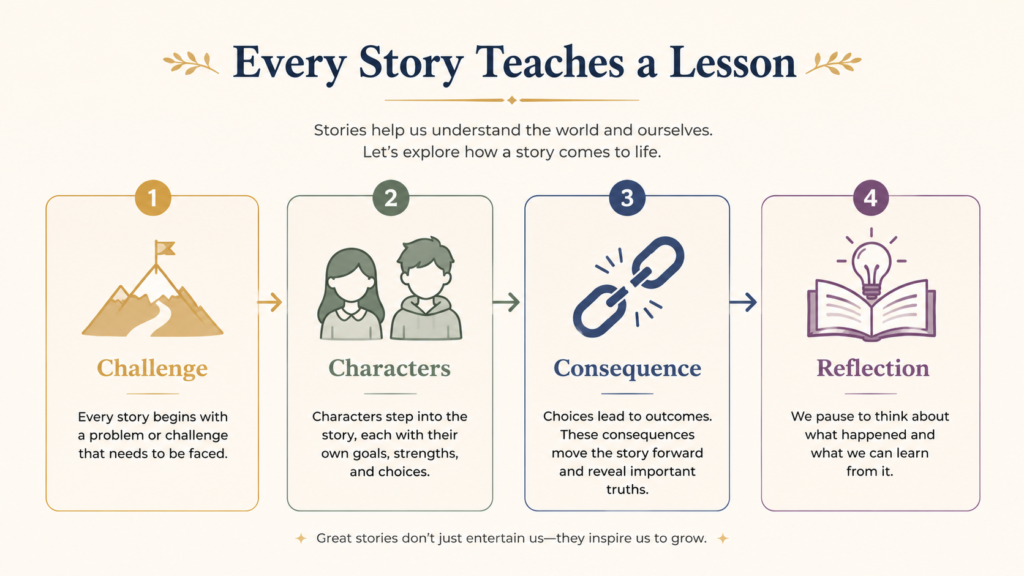
A relatable challenge
Every meaningful story begins with a problem. The challenge may involve temptation, fear, selfishness, injustice, or an important decision. Readers become emotionally invested because they recognize similar situations in their own lives.
Characters who represent ideas
The characters often symbolize human qualities rather than simply acting as individuals. A patient turtle may represent perseverance. A clever fox may symbolize intelligence — or sometimes manipulation. A generous elephant might embody compassion, while a proud lion can illustrate the dangers of arrogance.
Consequences that feel natural
Rather than explicitly stating «this is the lesson,» effective moral stories allow readers to observe the results of each choice. When characters act honestly, trust grows. When they behave selfishly, relationships often suffer.
A lesson that invites reflection
The best moral stories do not provide simplistic answers to every situation. Instead, they encourage readers to ask themselves: What would I have done? Did the character make the right decision? Could there have been another solution? What can I learn from this story?
Key Takeaway
- Every moral story shares four elements: a challenge, symbolic characters, natural consequences, and an invitation to reflect.
- Readers discover the lesson themselves rather than being told it directly.
Why Moral Stories Still Matter Today
Some people assume that moral stories belong to another era — an age before digital technology, instant communication, and artificial intelligence. Yet the opposite may be true. Modern life gives us access to more information than ever before, but information alone does not automatically develop wisdom, empathy, or sound judgment.
Stories help bridge that gap. They provide context, emotion, and perspective — allowing us to experience values through the decisions of fictional characters rather than simply being told what they mean.
Why Every Civilization Created Moral Stories
Long before books, schools, or the internet, people learned through stories. Parents shared them around fires. Elders used them to explain difficult decisions. Communities passed them from one generation to the next, preserving knowledge that could not easily be written down.
This pattern appeared independently across civilizations separated by thousands of miles and hundreds of years. Unlike laws or instructions, stories could be remembered, retold, and adapted.
Ancient Civilizations and the Birth of Moral Storytelling
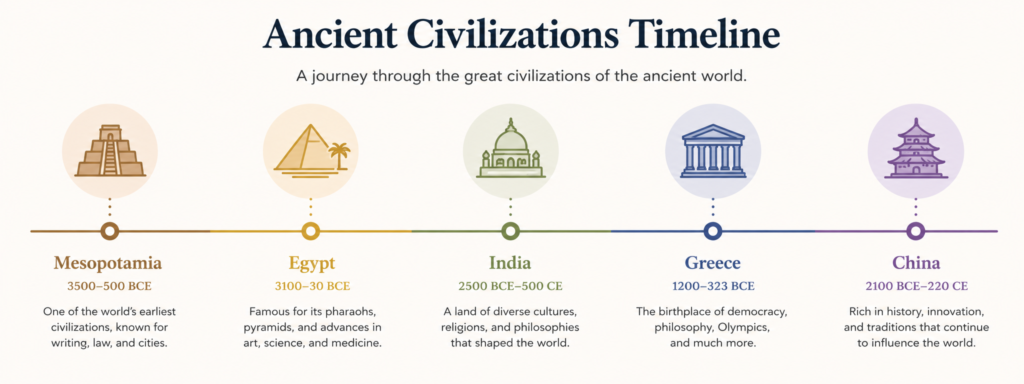
The earliest moral narratives appeared long before children’s literature existed. In ancient Mesopotamia and Egypt, stories were used to teach justice, responsibility, and leadership. In India, collections of wisdom tales helped rulers and young students understand politics, friendship, cooperation, and human behavior. In ancient Greece, storytellers transformed everyday situations into memorable lessons about pride, greed, honesty, and humility. In China, philosophers often relied on short narratives and parables to explain complex ideas about ethics, society, and personal growth.
📚 Historical Context
Although these traditions developed independently, they shared one remarkable characteristic: they taught values through experience instead of commands. Readers and listeners were invited to observe the consequences of choices rather than simply being told what to think.
Aesop and the Power of Animal Fables
Among the world’s most influential storytellers, few names are as closely associated with moral tales as Aesop. His fables, believed to have originated in ancient Greece, transformed ordinary animals into unforgettable teachers — a fox became a symbol of cleverness, a tortoise represented perseverance, a lion embodied strength (but sometimes arrogance), a wolf illustrated danger or deception.
They mattered because they reflected recognizable aspects of human nature.
Readers could discuss difficult subjects — pride, dishonesty, ambition, jealousy, or kindness — without directly criticizing real people. This symbolic distance made moral lessons easier to accept and easier to remember.
Read the full guide: Why Animal Characters Work So Well in Moral Fables →
The Panchatantra: Wisdom Through Story
Around the same period, another extraordinary collection of moral narratives emerged in ancient India: the Panchatantra. Rather than focusing solely on right and wrong, these stories explored decision-making, leadership, friendship, strategy, and practical wisdom.
💡 Did You Know?
Over the centuries, the Panchatantra was translated into dozens of languages and influenced storytelling traditions throughout Asia, the Middle East, Europe, and eventually the rest of the world.

Why Moral Stories Never Disappeared
History has transformed the way stories are shared — from oral traditions to handwritten manuscripts, printed books, illustrated children’s collections, audiobooks, podcasts, animated films, and digital platforms. Yet their purpose has remained remarkably consistent. Technology changes. Human nature does not.
From Ancient Wisdom to Modern Children’s Literature
Today’s moral stories often look different from the ancient tales that inspired them. Modern authors tend to write longer narratives, develop richer characters, and avoid presenting morality as a simple choice between «good» and «bad.» Characters make mistakes. They learn. They apologize. They grow.
Key Takeaway
- Moral storytelling arose independently across Mesopotamia, Egypt, India, Greece, and China.
- Aesop’s fables and the Panchatantra remain the most influential collections, both built on symbolic animal characters.
- Formats evolve. Lessons endure.
Why Stories Teach Better Than Rules
Imagine trying to teach a child an important lesson in two different ways. In the first, you simply say: «Always tell the truth.» In the second, you tell the story of a child who lies to avoid a small mistake, only to discover that one lie leads to another until trust is broken — and then show how honesty helps rebuild that trust.
Both approaches communicate the same principle. But only one is likely to be remembered years later.
Stories give meaning to information
Facts are important. Rules are necessary. But without context, both can feel distant and difficult to remember. Stories provide that missing context — context gives information emotional weight, and emotion is one of the strongest drivers of long-term memory.
Stories activate both emotion and reason
While reading a meaningful story, people naturally ask themselves: What would I do? Was that decision fair? Have I ever faced something similar? This internal dialogue transforms reading into reflection — one of the foundations of critical thinking.
Characters become safe teachers
🧠 Reflection
When a proud lion loses everything because of arrogance, readers are not being criticized personally. Instead, readers observe someone else’s choices. This creates emotional distance — and that distance makes honest reflection much easier.
Stories encourage empathy
Every meaningful story asks readers to see the world through someone else’s eyes. For a few minutes, readers leave their own perspective and experience another person’s emotions, fears, hopes, and motivations. This simple act strengthens empathy.
Lessons discovered are stronger than lessons given
⭐ Key Idea
When readers reach their own conclusions, the learning becomes personal. Instead of remembering someone else’s advice, they remember their own realization. The best moral stories never force wisdom upon readers — they invite them to find it.
Why this matters more than ever today
Modern life gives us instant access to information. Artificial intelligence can answer questions almost instantly. Yet information alone does not automatically create wisdom. Stories bridge the gap between knowledge and understanding.
When readers reach their own conclusions, the learning becomes personal.
Key Takeaway
- Stories succeed where rules fail because they engage emotion, not just logic.
- Emotional distance from symbolic characters makes reflection safer and more honest.
- A lesson the reader discovers themselves is remembered longer than one they’re told.
Why Moral Stories Matter for Children
Children are not born knowing how to resolve conflicts, understand fairness, manage disappointment, or recognize the impact of their actions on others. Moral stories play an important role in that process because they provide children with safe opportunities to explore situations they may not yet have encountered in real life.

Stories help children build emotional intelligence
One of the greatest benefits of moral stories is that they help children recognize and understand emotions. When a character feels lonely after excluding a friend, children begin to recognize loneliness. When another character overcomes fear through courage, they learn that bravery is not the absence of fear — it is acting despite it.
Stories teach empathy without lectures
Parents often tell children to be kind. Teachers remind students to respect others. But stories allow children to feel why kindness matters.
Stories encourage better decision-making
Every moral story revolves around choices. As readers follow these decisions, they begin evaluating possible outcomes before the story reveals them — a habit of prediction that strengthens critical thinking.
Stories make values memorable
Children rarely remember a list of classroom rules years later. Yet many adults still remember stories they heard in childhood — because stories connect information with emotion.
Reading together creates conversations
Perhaps the greatest strength of moral stories is that they do not end when the final page is turned. In many families, the most valuable moments happen afterwards.
Moral stories grow with the reader
A six-year-old may enjoy the adventure. A ten-year-old may notice the lesson. A teenager may question the characters’ decisions. An adult may discover entirely new meanings shaped by personal experience. The story has not changed. The reader has.
Practical ways parents can use moral stories
- Read together instead of asking children to read alone.
- Pause occasionally to ask open-ended questions.
- Encourage children to predict what might happen next.
- Discuss why characters made certain choices instead of focusing only on whether they were «good» or «bad.»
- Relate the story to everyday situations children already understand.
- Allow children to reach their own conclusions whenever possible.
Key Takeaway
- Children may forget instructions, but meaningful stories often remain with them for life.
- Stories give children a safe place to explore emotions and practice decision-making.
- Read the full guide for age-by-age themes and deeper conversation prompts.
Read the full guide: Why Moral Stories Matter for Children →
Why Adults Still Need Moral Stories
Many people assume that moral stories belong exclusively in childhood. Yet history tells a different story. Many of the world’s greatest collections of moral tales were originally written for adults, leaders, philosophers, and future rulers.
The same story can teach different lessons
A child may focus on the adventure. A teenager may notice the conflict. An adult often sees the difficult choices hidden beneath the surface.
The story remains exactly the same. Only the reader has changed.
Stories help adults reflect without feeling judged
Advice can sometimes feel confrontational. Stories take a different approach — rather than criticizing readers directly, they invite them to observe another person’s decisions. Instead of asking «what is wrong with me?» they begin asking, «what can I learn from this?»
Moral stories offer timeless leadership lessons
Throughout history, moral stories have explored qualities that remain essential for leaders today: humility instead of arrogance, integrity instead of convenience, patience instead of impulsiveness, compassion alongside authority, wisdom beyond intelligence.
Stories help us navigate ethical gray areas
Real life rarely presents perfect choices. Unlike simple rules, moral stories acknowledge that many important decisions involve uncertainty.
That is why moral stories still matter today more than ever.
Read the full guide: Why Adults Still Need Moral Stories →
Why Animal Characters Work So Well
If moral stories are meant to teach people, why do so many of them feature animals instead of humans? Animal characters create a safe distance between readers and the lesson.
| Animal | Common Symbolic Meaning |
|---|---|
| Fox | Intelligence, cleverness, sometimes deception |
| Lion | Strength, leadership, pride |
| Owl | Wisdom, reflection, knowledge |
| Turtle | Patience, perseverance |
| Ant | Hard work, discipline, cooperation |
| Rabbit | Kindness, vulnerability, hope |
| Wolf | Instinct, danger, ambition |
| Elephant | Memory, compassion, responsibility |
One remarkable feature of animal stories is their ability to travel across languages, religions, and cultures. A fox remains recognizable whether the story is read in London, Tokyo, Nairobi, or Buenos Aires.
Read the full guide: Why Animal Characters Work So Well in Moral Fables →
The Science Behind Storytelling
One of the reasons moral stories have survived for thousands of years is that they align remarkably well with how people naturally learn.
🎓 Educational Insight — practice vs. citation
This section reflects established educational practice around narrative learning and perspective-taking. Where specific research is referenced elsewhere on Wisdom Tales, it is always named and sourced directly — we never imply a citation we can’t point to.
Narratives also encourage what researchers often describe as perspective-taking — the ability to imagine another person’s thoughts, emotions, and motivations. Stories do not replace critical thinking. They support it.
Stories rarely tell us what to think. They teach us how to think.
Read the full guide: The Science Behind Storytelling — What Research Actually Shows →
How Parents Can Use Moral Stories at Home
Reading a moral story is valuable. Talking about it afterwards is transformative. The greatest lessons rarely come from the final sentence of the story — they emerge during the conversations that follow.
For example: Why do you think the character made that choice? What would you have done differently? Was the ending fair?
Read the full guide: How Parents Can Use Moral Stories at Home →
How Teachers Can Use Moral Stories in the Classroom
Teachers have long recognized that stories can introduce complex ideas in ways that lectures often cannot. A well-chosen story creates a common experience that every student can discuss, regardless of background or ability.
| Subject | Possible Connection |
|---|---|
| Language Arts | Reading comprehension, vocabulary, creative writing |
| Social Studies | Citizenship, responsibility, leadership |
| History | Historical figures and ethical decisions |
| Science | Environmental responsibility and cooperation |
| Art | Character illustration and visual storytelling |
Read the full guide: How Teachers Can Use Moral Stories in the Classroom →
«What would I have done?»
Frequently Asked Questions
Are moral stories only for children?
No. Although many moral stories are written for young readers, timeless stories continue offering new insights throughout adulthood. As our experiences change, our interpretation of the same story often changes as well.Why do moral stories often use animals?
Animals provide symbolic characters that make human behavior easier to explore without directly criticizing individuals. Their universal nature also allows stories to travel across cultures.What values do moral stories usually teach?
Common themes include honesty, kindness, courage, humility, gratitude, responsibility, empathy, perseverance, respect, forgiveness, and wisdom.Are moral stories based on real events?
Some are inspired by historical events or traditional folklore, while others are entirely fictional. What matters most is not whether the story happened, but the truth contained in its lesson.How long should a moral story be?
There is no perfect length. Some powerful lessons fit into a single page, while others require longer narratives. The effectiveness of a story depends on its clarity, emotional impact, and ability to encourage reflection.Can moral stories improve critical thinking?
Yes. Good stories encourage readers to evaluate decisions, predict consequences, compare perspectives, and discuss alternative solutions rather than simply accepting information.What makes a moral story memorable?
Characters readers care about, meaningful conflict, believable consequences, emotional connection, and a lesson that readers discover naturally instead of being explicitly told.Why are moral stories still relevant in the digital age?
Technology changes how stories are shared, but it does not change the human need for wisdom, empathy, and meaningful reflection.
If this resonated with you
Explore The Labyrinth of Time collection — stories built the same way this guide describes: a challenge, symbolic characters, natural consequences, and a lesson readers discover for themselves. Discover our books
One thoughtful story and one reflection question, delivered weekly.Join
WT
Wisdom Tales Editorial Team
Helping readers become wiser, kinder, and more thoughtful — one story at a time. We never invent facts or studies, and we always explain uncertainty.
Last updated July 2, 2026