Incredible discounts on children's books!
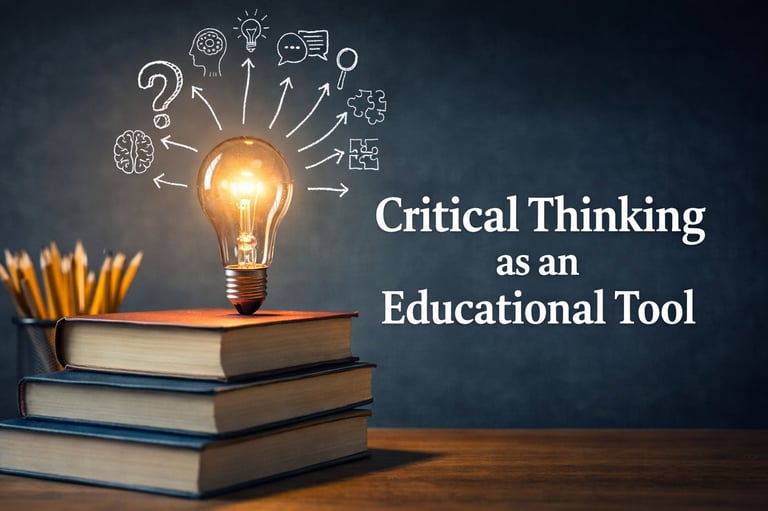
Critical Thinking as an Educational Tool
Critical thinking is a vital skill in modern education. It empowers learners to question assumptions, analyze information, and make reasoned decisions. As an educational tool, it goes beyond memorization, encouraging students to engage deeply, solve problems effectively, and think independently in an ever-changing world.
IYOBOSA EDOKPOLOR
1/9/20261 min read
Critical thinking is the discipline of thinking clearly, independently, and responsibly. It trains the mind to evaluate information, detect fallacies, recognize bias, and judge ideas based on evidence rather than emotion or authority. At its core, it relies on two complementary tools: deductive reasoning and inductive reasoning.
Deductive thinking is the tool of certainty. It moves from general principles to specific conclusions. When the premises are true and the reasoning is valid, the conclusion must be true. In education, deduction teaches discipline, consistency, and logical rigor. It helps learners test claims, expose contradictions, and reject false conclusions that do not logically follow from established facts. Inductive thinking is the tool of discovery. It moves from specific observations to broader generalizations. Its conclusions are not guaranteed, but they are informed by patterns, evidence, and experience. In education, induction develops curiosity, open-mindedness, and humility. It teaches learners to form beliefs tentatively, revise them when new evidence appears, and avoid absolute claims where certainty is not possible. Used together, deduction and induction sharpen judgment. Deduction guards against illogical beliefs; induction guards against dogmatism. One checks validity, the other tests plausibility.
Critical thinking emerges when learners know when to demand certainty and when to accept probability, when to question language, motives, and authority, and when to correct themselves rather than defend errors. An educated mind is not one that never errs, but one that can recognize error, revise belief, and communicate truth clearly. That is the true maturity that critical thinking—through deductive and inductive tools—aims to build.
Together, these tools cultivate moral maturity:
Honesty: refusing to distort facts or language.
Accountability: recognizing and correcting mistakes.
Courage: speaking truth clearly, even when inconvenient.
Responsibility: resisting manipulation, ambition, and deceptive rhetoric. A morally educated mind does not hide behind confusion or power. It thinks clearly, speaks truthfully, corrects itself willingly, and places the common good above personal ambition. That is the ethical goal of critical thinking.
By Iyobosa Edokpolor
Wisdom Tales Books
Sale of bedtime stories and fables for kids and adults.
phone & mail
contact
iyobosa@wisdomtalesbooks.com
+34-692-830-740
© 2025. All rights reserved.